
Behind every project lies a unique personality, set of beliefs, and experience. Our interview series takes you into the world of UX-Republic consultants and their daily work.
In this eighth episode, discover the profile of Sonia , a CRO consultant and Web Analyst at UX-Republic since April 2026. Specializing in conversion rate optimization for over four years, she works within the agency's Performance team. She shares her passion for data, her vision of evidence-based decision-making, and the emergence of this new digital profession.
From digital marketing to a passion for data and CRO
Paul: Can you introduce yourself and tell us about your academic and professional background?
Sonia: I am Sonia, a CRO consultant and Web Analyst at UX-Republic since April 2026. Having graduated with a master's degree in e-commerce and digital marketing from Sup de Pub in 2023, it was during my studies that I discovered data analysis.
I specialized in CRO very early on, working for major e-commerce sites like Gamm Vert and Jardiland within the TERACT group, at La Maison du Chocolat , then as a freelancer for the Etam group , as well as at Bouygues Telecom as CRO manager. My arrival at UX-Republic marks my first agency experience, where I am particularly involved in structuring our Performance offering.
From design to continuous optimization
Paul: What prompted you to specialize in behavioral analysis and conversion rather than design per se?
Sonia: I dabbled in Product Design during redesigns, but what I was passionate about in CRO was following a project from start to finish.
We can identify a point of friction using data , imagine several avenues for improvement, and then test them to see what actually works for users. It's this cycle of observation, hypothesis, and validation that I find particularly interesting.
CRO also requires humility and curiosity . A strategy that worked for one brand won't necessarily work elsewhere, because target audiences and usage patterns differ. You have to adapt and constantly test your choices against the results.
At the Performance hub: from strategy to the field
Paul: What does the daily life of a CRO expert look like within the agency?
Sonia: My daily work is organized around two dimensions. The first is quite strategic: I support the director of the Performance division and the sales teams to structure our offers , build our methodologies and raise awareness of CRO among our clients.
The other part is more operational. In particular, I conduct UX and analytics audits to understand user journeys and identify when users encounter difficulties or abandon their browsing.
To do this, I combine quantitative data, for example from Google Analytics, with qualitative data from behavioral tools like Hotjar . From this, I derive concrete recommendations and proposals for experiments for the clients I support in implementing and monitoring the impact of these optimizations.
Data and UX alignment: the true value of CRO
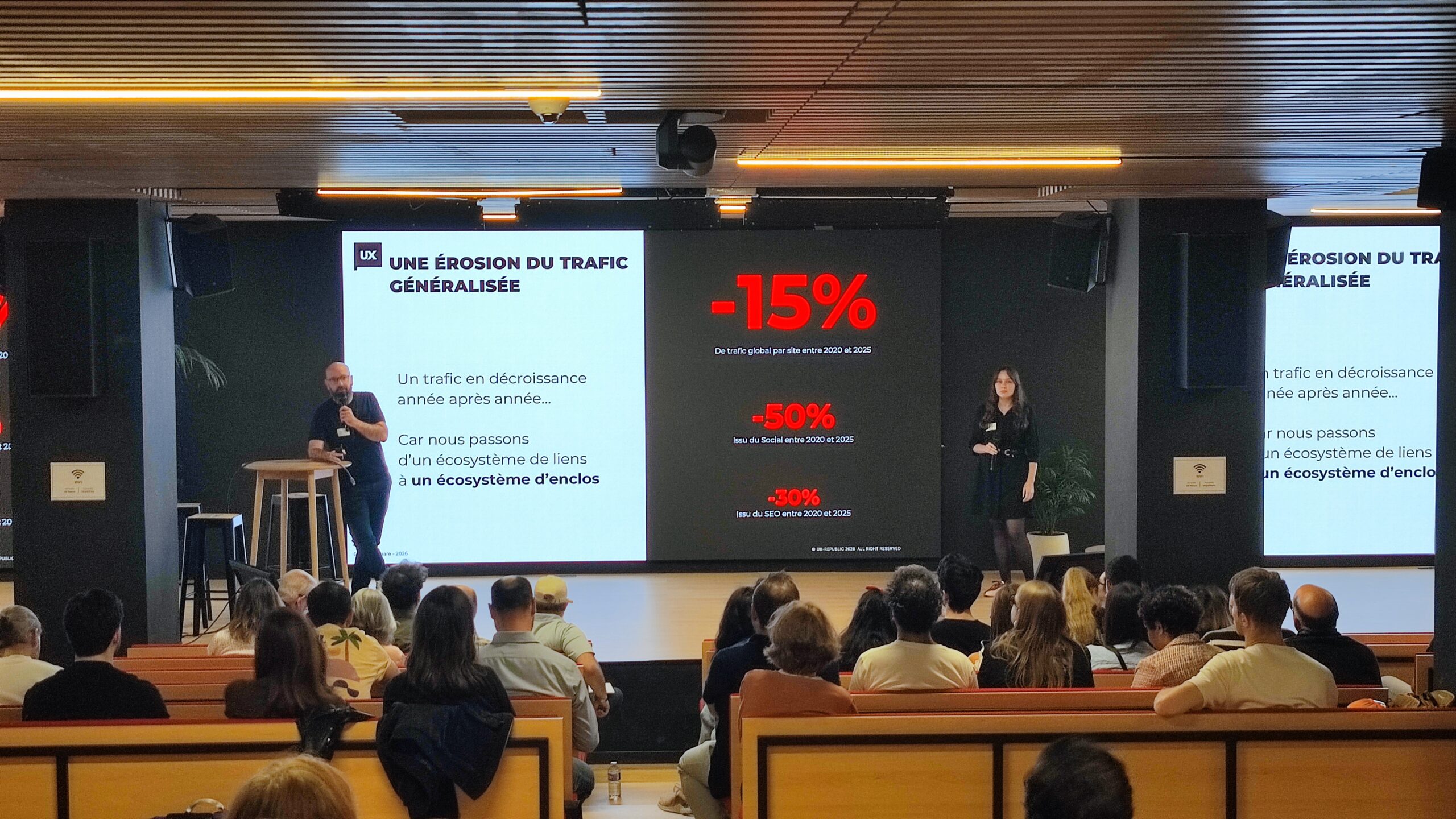
Paul: At UX Reboot 2026, you co-hosted a conference on the shift from UX to CX. Why is traditional UX no longer sufficient without data?
Sonia: A website can be visually stunning but ineffective if it doesn't meet the real needs of its users . UX analyzes the "how ," while CRO measures the "how much ," which is why I believe they are inseparable.
Data allows us to quantify problems and avoid making decisions based solely on intuition or internal opinions. It provides concrete elements for understanding behaviors, prioritizing issues, and measuring the impact of implemented optimizations .
This is where CRO (Customer Review Optimization) becomes truly meaningful: optimization performed on a website continues to generate value over time and, in particular, reduces acquisition costs. The idea is to build a more effective experience based on actual usage patterns.
AI agents and new ways to browse the web
Paul: The emergence of generative engines and AI agents is disrupting web traffic. What does this change for user journey analysis?
Sonia: Whether you are dealing with a human or an LLM, the fundamentals remain the same: a clear structure, good technical performance and well-organized data benefit both the user and the AI.
In our daily lives, AI also helps us save time on certain repetitive tasks or on data formatting. This allows us to dedicate more time to high-value analysis.
However, we must remain particularly vigilant regarding the confidentiality of our clients' strategic data.
Testing, learning, and questioning one's certainties
Paul: What is the biggest challenge for CRO today and what message would you like to convey?
Sonia: One of the major challenges remains raising awareness of the culture of experimentation . In France, CRO is still a relatively new approach for many companies, which may hesitate to invest in the necessary tools or methodologies. Furthermore, it's a discipline that must be integrated into every stage of a project's value chain , and not considered as an isolated expertise.
We also need to demystify A/B testing . On social media, we often see spectacular results, but the reality is much more nuanced.
Even at giants like Amazon or Netflix, the majority of tests are neutral or even negative. Yet, a culture of testing is an integral part of their business model, used to mitigate risk in product development. An experiment that doesn't immediately improve conversion rates still teaches us something about the user. This is the essence of Test and Learn : accepting that you might not be right the first time in order to better guide decision-making.

Paul Courtois
Digital Marketing & Communications Assistant at UX-Republic
